

Hey there! I’m Dimity, mum to Poppy (three and a half) and Louie (18 months). If you’re starting solids with your bub and fumbling your way through it, you’re in good company. I’ve done the messy dance twice and, trust me, I definitely didn’t nail it on the first go.
I’m writing this one with my friend Susan, who co-hosts the Bright Star Kids Parenting Podcast with me. She’s mum to Jamie, who’s 13 and well past the puréed pumpkin chaos, so she’s got the kind of hindsight I’m still chasing!
We’re no gurus (or health professionals), just two mums who tried, failed and laughed through it all. Here are nine real-life tips on starting solids for babies that we’d spill to any friend over a cuppa: the good, the bad and the sticky.
1. Follow Your Baby’s Feeding Cues

This one’s huge, and it comes from one of my toughest days as a mum. Poppy was little, and the formula tin said she needed a set amount. I tried so hard to get her there, offering the bottle again and again, but she just wouldn’t take the amount it recommended. When she projectile vomited after I practically forced her to finish a whole bottle, I felt so incredibly guilty. That’s when I stopped treating the amount on the tin as a target and started following her lead, something I carried right into starting solids.
Susan told me she wished she’d done the same when Jamie was a bub. She spent hours in the night trying to get him to drink the “right” amount, but he just never needed much.
The amount on the tin is a guide, because every baby is different, but the way you mix the formula isn’t. Pregnancy, Birth and Baby says to always make formula up exactly as the instructions say, and to let your baby’s hunger and fullness cues guide how much they drink. If a health professional has given you a feeding plan for your baby, stick with that.
2. Focus on Your Baby’s Growth Curve, Not the Percentile
Poppy has always been on the smaller side, and for a while I’d leave every check-up fixated on where she sat on the chart compared to other babies. What finally helped was understanding that one number on its own doesn’t tell you much. What matters is the pattern of growth over time, and whether your bub keeps growing along their own curve. Poppy was growing steadily along hers. She was just a petite little thing!
If you ever have concerns about your baby’s growth or feeding, chat to your GP or child health nurse. They’re the ones who can see the full picture.
3. Should You Start with Sweet or Savoury Foods?
There’s no hard rule here. Australian guidance says first foods can go in any order, as long as iron-rich foods are part of the mix from around six months.
I started Poppy on sweet foods, and she’s still got a sweet tooth! Susan swears by savoury first, but honestly, I’m not sure it would have changed much. Poppy’s just her own person. My take now? Do whatever works for you and your family. If you’ve cracked the code with savoury first, let me know, because we’re still debating it in our house.
4. Let Your Baby Explore Self-Feeding
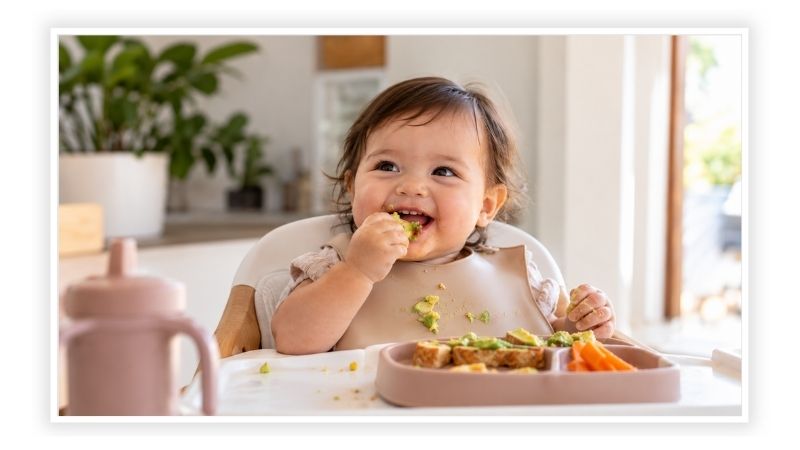
Poppy’s first real “big kid” meal? Avocado on toast, handed straight to her at six months. She didn’t love the avocado so much as the independence. Doing it herself was the win!
Susan had the same with Jamie. No chance with purées unless he could get his own hands messy or wield the spoon. Turns out, wanting control starts early!
Louie’s the same now. Sure, he can use a spoon, but I still let him go hands-on with veggies, because eating matters way more than the mess you have to clean up afterwards.
Whether you start with purées, baby-led weaning or a mix of both, what matters is that the texture suits what your baby can manage, they’re sitting upright, and you’re right there with them.
5. Learn How to Serve Baby’s First Foods Safely
Honestly, the scariest bit for me wasn’t what food to offer, but how to serve it without stressing about choking. Solid Starts was a lifesaver, because it shows you how to prep foods for your baby’s age, with pictures that made it so much less nerve-wracking. I used it every meal with Poppy and still check it with Louie when I’m unsure how to cut something up safely.
Gagging vs choking: how to tell the difference
It also helped to learn that gagging and choking aren’t the same thing.
Gagging is noisy: lots of coughing and spluttering, maybe a red face. It’s a normal reflex and just your baby learning to eat. As tough as it is, while they’re coughing and spluttering I try to let them work it out and not jump in straight away.
Choking is when something blocks the airway, and it’s an emergency. A choking baby may not be able to cry, cough properly or breathe, and their face or lips can change colour. It’s often quiet, but not always: a partly blocked airway can mean noisy or rattly breathing too. Raising Children Network has a clear picture guide to choking first aid for babies.
That’s why we always keep the kids sitting upright at meals and never leave them eating alone, even for a minute.
If you’d like to feel more prepared, the Australian Red Cross runs a First Aid for Babies and Children course, and St John Ambulance runs similar courses for parents in each state. In an emergency, always call 000.
6. Introduce Common Food Allergens Safely
Allergens made me almost as nervous as choking. What helped was knowing the advice has changed, and the experts now say not to delay them.
The current guidance from ASCIA, updated in 2026, is to give common allergy foods in your baby’s first year, by 12 months. In practice that means:
- Offering well-cooked egg and smooth peanut butter or paste (never whole nuts or pieces) soon after your baby starts solids.
- Trying only one new allergen per meal, so you can tell what caused it if there’s a reaction.
- Once an allergen’s in, keeping it in your baby’s diet at least once a week.
This goes for babies with eczema or a family history of allergies too. If that’s your family, it’s worth a chat with your GP or child health nurse before you start.
If you notice swelling of the lips, face or eyes, hives or welts, vomiting, difficult or noisy breathing, or your baby goes pale and floppy, stop giving that food and get medical advice. Call 000 straight away if it looks like a severe reaction.
7. Make Messy Mealtimes Easier
Less laundry, more sanity! Louie eats in just a nappy, gets a quick wipe, then it’s straight to the bath. No ruined outfits. Winning!
8. Adapt Family Meals for Your Baby
No way am I running a restaurant for three! For Louie, I just pull his bits out before saucing or mixing. He eats what we do, just in a way he can handle. It keeps dinners easy and introduces new foods to everyone.
For younger babies, that means serving family food in a texture they can manage, with no added salt or sugar, and skipping hard foods like raw apple, raw carrot and whole nuts, which are choking risks.
9. Try Apple Purée When Introducing Vegetables
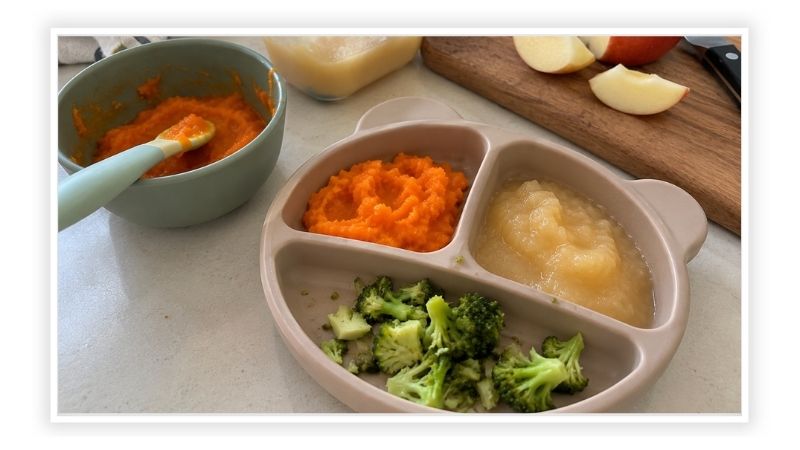
Susan’s tip? Use a bit of apple purée as a bridge, then cut it back once your bub is eating the veg. It’s what worked for her, not a rule. Yes, some people are strict on sugar, but a freezer full of untouched food is a real pain!
The Second Time Round Really Is Easier
Not because Louie’s a unicorn baby (though he’s pretty chilled), but because I don’t second-guess myself as much. I worry less, I let him explore food more, and it’s honestly so much less stressful. And I get to enjoy watching him try new foods!
Susan and I definitely aren’t parenting gurus, just two mums who’ve been through it and want to share what worked (and what didn’t). For anything specific to your baby, your GP or child health nurse is always the best person to ask.
Listen to the Episode
If you’d like to hear Susan and me chat through all of this (and plenty more), the full episode of the Bright Star Kids Parenting Podcast is on YouTube, Spotify and Apple Podcasts. Have a listen and let us know what worked for your family.
You’ve got this, mumma. Every baby’s different. Trust your gut, and don’t be afraid to make a mess along the way!
Until next time,
Dimity Stefanovski


